

AI Governance & Global South Voices: Insights from the RegulatingAI Podcast with Sanjay Puri & Mehdi Jomaa

RegulatingAI Podcast
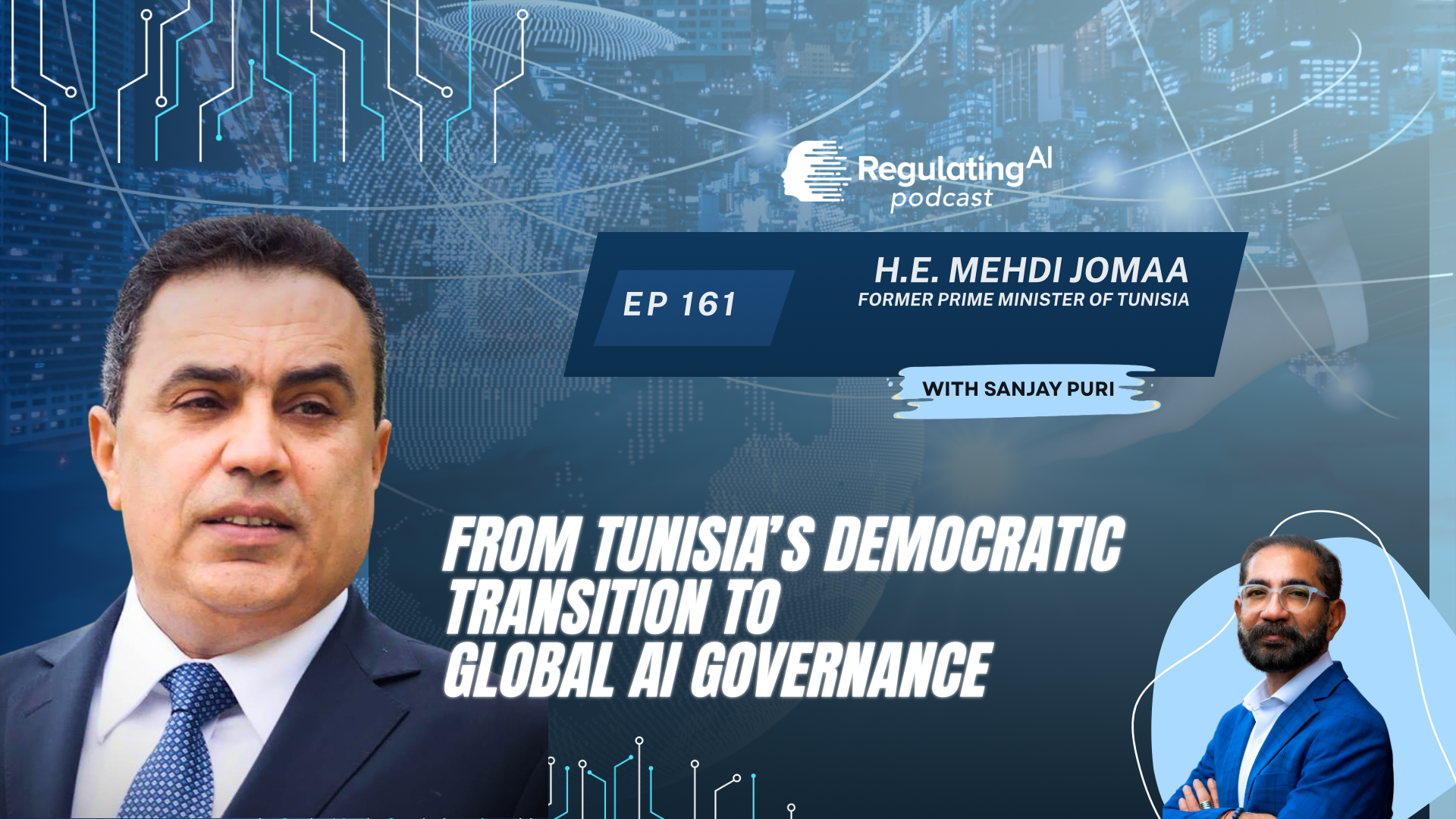
Mehdi Jomaa, former Prime Minister of Tunisia, with Sanjay Puri, President, RegulatingAI
On the RegulatingAI Podcast, Sanjay Puri and Mehdi Jomaa discuss AI governance, global cooperation, and why the Global South must help shape AI’s future.
Artificial intelligence is rapidly transforming the way governments, businesses, and societies operate. But as innovation accelerates, an equally important question emerges: how should the world govern AI responsibly? On the RegulatingAI Podcast, host Sanjay Puri brought together global perspectives to address exactly this challenge.
In this episode, Sanjay Puri is joined by Mehdi Jomaa, former Prime Minister of Tunisia, engineer, and global policy leader. Their conversation explores how governments can approach AI governance, why leadership must adapt to technological change, and why voices from the Global South are essential in shaping the future of artificial intelligence.
Why Leaders Must Understand AI—Even Without Being Experts
A key theme discussed by Mehdi Jomaa on the RegulatingAI Podcast is that leaders do not need to be AI engineers to govern AI effectively. However, they must develop a basic understanding of how the technology works and how it impacts society.
Artificial intelligence now influences everything from financial systems and national security to healthcare, education, and public services. According to Mehdi Jomaa, political and policy leaders must build technological awareness to make informed decisions about regulation, investment, and long-term national strategy.
Without this understanding, governments risk falling behind the pace of innovation.
Lessons from Aerospace: Innovation and Regulation Must Work Together
Drawing from his background in engineering and the aerospace industry, Mehdi Jomaa shared an interesting comparison. Aerospace has always balanced rapid technological advancement with strict safety oversight.
This model offers an important lesson for AI governance.
Rather than slowing innovation, regulations can help establish trust, safety, and accountability. Risk detection, auditing systems, and continuous testing can ensure that AI technologies develop responsibly while still encouraging experimentation and growth.
For policymakers, the goal should not be to restrict innovation—but to guide it.
The Case for Global AI Governance
Another major question raised by Sanjay Puri on the RegulatingAI Podcast is whether the world needs international cooperation on AI regulation.
Unlike many traditional technologies, AI is inherently global. Systems developed in one country are quickly deployed across multiple markets and cultures.
Mehdi Jomaa emphasized that this reality makes international collaboration essential. Global governance principles could help address issues such as data security, algorithmic transparency, and ethical AI deployment.
Without shared frameworks, fragmented regulations could slow innovation and create regulatory confusion.
Ensuring the Global South Has a Voice
One of the most important aspects of the conversation between Sanjay Puri and Mehdi Jomaa was the need to ensure that the Global South participates in shaping AI governance.
Today, most AI systems are trained primarily on Western datasets and languages. Yet regions such as Africa represent a significant portion of the global population.
Mehdi Jomaa pointed out that Africa accounts for roughly 18 percent of the world’s population but only a small fraction of global data infrastructure. This imbalance risks creating AI systems that overlook local languages, cultural contexts, and regional needs.
Including emerging economies in AI policy discussions is therefore not just fair—it is necessary for building inclusive and globally relevant technology.
Africa’s Opportunity in the AI Era
Despite the challenges, Mehdi Jomaa believes the AI revolution also presents major opportunities for developing economies.
Countries across Africa are investing in digital infrastructure, education, and technology ecosystems. By collaborating regionally and aligning policies, African nations could strengthen their role in the global AI economy.
Tunisia itself, Mehdi Jomaa noted, has strong academic institutions and a growing technology sector that could position it as a regional innovation hub.
Shaping a Collaborative AI Future
The conversation between Sanjay Puri and Mehdi Jomaa on the RegulatingAI Podcast ultimately highlights a powerful message: the future of AI will depend as much on governance as it does on technology.
As artificial intelligence continues to evolve, leaders must work together—across countries, industries, and cultures—to build systems that are innovative, responsible, and inclusive.
Discussions like those on the RegulatingAI Podcast serve as an important step toward ensuring that the AI revolution benefits not just a few nations or companies but the entire world.
Upasana Das
Knowledge Networks
email us here
Visit us on social media:
LinkedIn
Instagram
Facebook
YouTube
X
Legal Disclaimer:
EIN Presswire provides this news content "as is" without warranty of any kind. We do not accept any responsibility or liability for the accuracy, content, images, videos, licenses, completeness, legality, or reliability of the information contained in this article. If you have any complaints or copyright issues related to this article, kindly contact the author above.
